
Hospitality Industry Legal Risks: North Carolina Restaurant Operator Sued By EEOC For “Religious Discrimination”; Muslim Food Prep Worker Fired For Refusing To Cut Off Beard

“…(plaintiff) applied for a job with a Bojangles’ restaurant in Charlotte and was interviewed for a food prep position…the manager informed Charles that he might need to cut his beard, to which Charles responded that he could not cut his beard for religious reasons, informing her that EEOChe was a Muslim. Charles was hired and worked at the restaurant on May 18 without incident…Charles reminded the manager that he could not cut his beard because of his religion, and requested an accommodation of wearing a beard net, similar to a hair net, which the restaurant manager refused. The restaurant manager told Charles to leave the restaurant, and to not return to work until he shaved off his beard. Charles refused to shave his beard and was consequently fired…”

Bo-Cherry, Inc., a North Carolina corporation that operates several Bojangles’ restaurants in the Charlotte metro area, violated federal law when it failed to accommodate an employee’s religious beliefs and then fired him because of his religion, the U.S. Equal Employment Opportunity Commission (EEOC) charged in a lawsuit filed today.

According to the EEOC’s complaint, Devin Charles has been a practicing Muslim for the past 14 years. As a male Muslim member of his sect of the Sunni branch of the Islamic faith, Charles is required to grow and maintain a beard and is not allowed to trim or cut his beard unless it exceeds the length of his fist when holding his beard in his closed hand under his chin, commonly referred to as “fist length.” In accordance with his sincerely held religious beliefs, Charles has not trimmed or cut his beard unless it exceeded a fist length

The manager instructed Charles that her supervisor, the district manager, had come to the restaurant, seen Charles’ beard and instructed her to tell Charles that he needed to shave off his beard to continue working for Bojangles’.

Title VII of the Civil Rights Act of 1964 requires employers to make reasonable accommodations for the sincerely held religious beliefs of employees as long as doing so does not pose an undue hardship on the employer. The EEOC filed suit in U.S. District Court for the Western District of North Carolina, Charlotte Division (EEOC v. Bo-Cherry, Inc. d/b/a Bojangles, Civil Action No. 3:13-cv-00210) only after first attempting to reach a pre-litigation settlement through its conciliation process. The EEOC seeks back pay, compensatory damages, punitive damages and reinstatement or front pay. The complaint also seeks injunctive relief.

“Under federal law, employers have an obligation to attempt a fair balance between an employee’s right to practice his or her religion and the operation of their business,” said Lynette A. Barnes, regional attorney for the EEOC’s Charlotte District Office. “This case demonstrates the EEOC’s commitment to fighting religious discrimination in the workplace.”

For more:  http://www.eeoc.gov/eeoc/newsroom/release/4-4-13.cfm

Leave a Comment

Filed under Labor Issues, Liability, Management And Ownership, Risk Management, Training

Hospitality Industry Employment Solutions: Hotel Owners Must Utilize “Modern Technology And Processes” To Increase Positive Working Atmosphere For “Back Of House Employees”

“…modern technology that maximizes efficiency is lending a hand to the process of putting employees in a positive state of mind…take good care of the staff and they’ll return the favor to the guests…Placing the newest technology in the back of house at any resort is just as important as using it for guestrooms and amenities…”

Hotel Employee SatisfactionAny customer-centric business is only as good as its weakest link. Money spent on a strong back of house will surely pay dividends. It’s crucial for the back of house at a resort to create a pleasant, efficient atmosphere for the employees which, in turn, influences the service they provide to guests and increases productivity.

At Revel, the new $2.4-billion luxury property in Atlantic City, New Jersey, the back of house is as nice as the guest amenities at many resorts. With more than 1,800 rooms, 10 swimming pools, 14 restaurants and more than 4,000 employees, having an efficient, enthusiastic and motivated staff is critical for Revel.

  • Efficient elevators At Revel, the elevators are reminiscent of Disney World. You walk to where you need to go, leave the wardrobe area and then magically appear somewhere else. The elevators were designed to be fast. By combining group dispatching with directed elevator shafts and proper speed settings, it’s easy to get employees where they need to be without delay. The employee elevators at Revel move with efficiency and on multiple tracks, so employees aren’t stuck wasting time traveling from location to location. Instead, the speed instills a sense of energy that’s designed to prepare the staff on a positive note.
  • Wardrobe conveyor systems Elevators aren’t the only technological advancements. Employees never have to worry about misplaced work uniforms, having to press their uniform or leaving a piece behind accidentally. Meet Revel’s wardrobe process and conveyor systems. Each employee is provided three uniforms (one to wear, one as a backup and one that is being laundered).
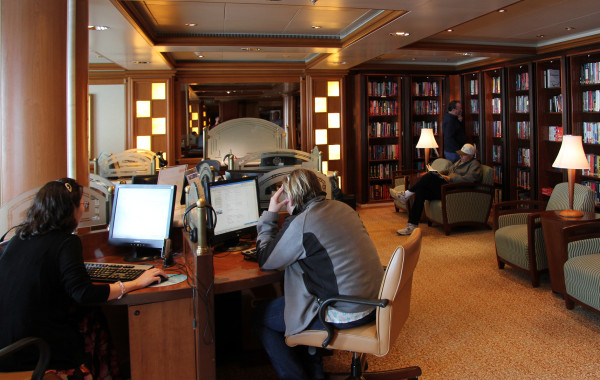
  • Touchdown stations Employees can check email and message people from touchdown stations. These stations enable employees to stay in touch with the outside world while at work and when it’s appropriate. Additionally, they can use the touchdown stations to get the latest information on the events in the hotel and other information that prepares them to be a resource for any guest.
  • Communications Instant communication is a major part of today’s customer service. By communicating through cell phones—sometimes provided by employers—supervisors have quick and easy ways to relate situations to all needed members of staff. Immediate response better serves the guest.
  • Efficient food services When employees have to leave work for lunch or worry about paying for food, their attitude on the job can be affected. By providing employees with a hassle-free way to get their meals in a relaxing and calm environment, they can focus on the job at hand. Quick meals, such as muffins and coffee in the morning and sandwiches and sodas at lunch, are readily available in the employee dining room. This is particularly important for 15-minute mid-shift breaks. Employees are provided access to upscale dining with multiple choices that are available 24 /7.

For more:  http://www.hotelnewsnow.com/Articles.aspx/10237/Back-of-house-technology-makes-staff-happier

Leave a Comment

Filed under Guest Issues, Labor Issues, Management And Ownership, Risk Management, Technology, Training

Hospitality Industry Crime Risks: Washington Hotel Manager And Staff Assist In Arrest Of “Identity Theft Ring”; Forged ID Cards, Computers And Printers Discovered In Room

…the hotel manager called the police to report suspicious men who had booked a room. As he was talking to officers, the identity theftsuspects ran out a back door of the hotel and left in a vehicle…the manager called back to report that his staff found “suspicious computer equipment” and documents strewn about a room they had been scheduled to clean. Detectives served a search warrant on the room…three suspects returned to the hotel that night to get the items they left in the room and were arrested…”

Mukilteo police arrested three men on Thursday in connection with an identity-theft ring after hotel cleaning staff found a room full of forged IDs and the equipment to manufacture them. The room at the hotel in the 8500 block of the Mukilteo Speedway was filled with computers, printers, mail and paperwork that didn’t belong to anyone registered for the room, said Cheol Kang, spokesperson for the Mukilteo Police Department.

A search warrant also recovered numerous ID cards with different names but the same photo of one of the men, as well as a printer with pages of blank check paper.

A 32-year-old from Lake Stevens, a 31-year-old from Renton and a 28-year-old from Everett were booked into Snohomish County Jail for investigation of financial fraud and forgery. Kang said the three men were already under investigation by other law-enforcement agencies for identity theft, fraud and other financial crimes.

For more:  http://mukilteobeacon.villagesoup.com/p/identity-theft-ring-busted/983738

Leave a Comment

Filed under Crime, Guest Issues, Management And Ownership, Risk Management, Theft

Hospitality Industry Employment Risks: Wisconsin Restaurant Servers File “Wage Violation Class-Action Lawsuit”; Claims Owners “Transferred Cost Of Doing Business” To Workers

“…the complaint says servers were forced to pay for their uniforms, aprons, hot pads to serve fajitas, order pads and name tags — and that’s not Hospitality Industry Wage Violation Lawsuitsall…anytime a customer walked out without paying the bill, the servers had to pay. Anytime a customer said, this is not what I ordered, food or alcohol drink, the server had to pay for that…the owners were essentially transferring the cost of doing business on to the servers, who were only being paid $2.33 an hour…”

A group of servers at La Fuente restaurant have filed a class action lawsuit against the restaurant — saying they are sick of footing the bill for food sent back to the kitchen. The claim says servers were expected to work and not get paid — and that they were stuck with the bill when customers would skip out. Larry Johnson is a labor attorney representing servers at two La Fuente locations. Johnson says it was written policy to have the servers start shifts early and prepare the restaurant, but they weren’t allowed to clock in until customers arrived, and so now, a server has served the owners with a class action lawsuit.

“Setting up tables, putting rolling silverware, filling salt shakers, working, making coffee, all that kind of stuff to get the restaurant ready,” Johnson said.

The suit now requests those unpaid wages and if they win the case, the court could double it, along with attorneys fees. Johnson says it is too early to know how much money that could be, but he says it’s the price companies pay when they don’t follow the law.

For more:  http://fox6now.com/2013/04/02/group-of-la-fuente-servers-file-class-action-suit-against-owners/

Leave a Comment

Filed under Employment Practices Liability, Labor Issues, Liability, Management And Ownership, Training

Hospitality Industry Property Risks: Wisconsin Restaurant Fire Caused By “Improperly Stored Ashes”; $20,000 In Damage To Walls And Siding

Restaurant FireAshes that weren’t properly disposed of caught the wood siding on fire this morning, causing around $20,000 in damage.  The building had to be ventilated of smoke.

There’s some cleaning up to do before McGrath’s Fish House in Milwaukie can re-open for business.

A police officer patrolling the parking lot spotted the flames. Firefighters say make sure to put ashes in a non-combustible container of water to cool them before putting in the trash.

Leave a Comment

Filed under Fire, Labor Issues, Liability, Risk Management, Training

Hospitality Industry Legal Risks: Arizona Restaurant Settles “Disability Discrimination Lawsuit” For $65,000; Server With Traumatic Brain Injury Was Fired By New Manager

“…(the plaintiff) worked tirelessly to be a good server after suffering a traumatic brain injury. The ADA prohibits EEOCemployers like Outback from firing individuals like John who add so much to the workplace…”

Outback Steakhouse will pay $65,000 and furnish other relief to settle a disability discrimination lawsuit filed by the U.S. Equal Employment Opportunity Commission (EEOC), the agency announced today.

The EEOC’s lawsuit, EEOC v. OSI Restaurant Partners, LLC d/b/a Outback Steakhouse and OS Restaurant Services, Inc., Civil Action No. 2:11-cv-01754-NVW, charged Outback with firing server John Woods days after a new manager took over at Outback’s Phoenix Metrocenter location. According to the EEOC’s suit, John Woods had worked successfully under Outback’s prior manager, but a new manager terminated Woods because of his disability, traumatic brain injury.

Disability discrimination violates the Americans with Disabilities Act (ADA). The EEOC filed suit in U.S. District Court of Arizona after first attempting to reach a pre-litigation settlement through its conciliation process.

After the court denied Outback’s motion for summary judgment, Outback agreed to a 24-month consent decree that requires the company to pay Woods $65,000; revise its policies concerning disability discrimination; train its Arizona managers on the laws prohibiting disability discrimination; and post notices in Arizona Outback Steakhouses regarding employees’ rights under the ADA.

“Managers cannot fire employees because of their mistaken beliefs about what individuals with disabilities can accomplish,” EEOC Phoenix District Director Rayford Irvin said. “We are pleased with the resolution of this case, and we are hopeful that this agreement will help prevent discrimination in the workplace going forward.”

For more:  http://www.natlawreview.com/article/outback-steakhouse-to-pay-65000-to-settle-eeoc-disability-discrimination-lawsuit

Leave a Comment

Filed under Employment Practices Liability, Injuries, Labor Issues, Liability, Management And Ownership, Risk Management, Training

Hospitality Industry Data Security Risks: Hotels Are At Significant Risk Of “Large-Scale Hacking” Of Guest Personal Information, Including Information In Reservation Systems

“Data security is becoming an issue of significant importance in the hospitality industry…(because of) an increase in hacks and malware attacks, which frequently target hotel systems because they’re a rich source of cybercrime in hotelspersonal information… hackers aren’t just targeting data on hotel systems but also the information passed along to reservations systems…credit card theft is much easier — and more likely — through large-scale hacking…another reason hotel guests are vulnerable to having their personal information stolen: They’re easily distracted.”

Several days after Traci Fox visited a small independent resort in the Catskill Mountains, she received an unexpected call from a shoe store. Where did she want it to ship the $400 worth of pricey sneakers that she’d ordered?

Fox believes that her hotel may have compromised her credit card information. At least one government agency shares her concerns. Last summer, the Federal Trade Commission sued Wyndham Hotels, alleging that the company had failed to protect its customers’ personal information. As a result, the FTC claims, hundreds of thousands of credit card numbers fell into the wrong hands, leading to millions of dollars in fraud-related losses. Wyndham denies any wrongdoing and is fighting the suit.

The problem may run deeper than the theft of credit card numbers, however.

The personally identifiable information in your guest profile, such as your home address, your license plate number and your date of birth, which is attached to your reservation, can end up in the hands of a third party that offers little or no warranties about how it will protect your data. “These kinds of areas are more worrisome than some huge Visa bill,” says hotel consultant Marion Roger. “Once your identity has been cloned, you can easily spend years and hundreds of thousands in legal and other fees.”

For more:  http://www.washingtonpost.com/lifestyle/travel/the-navigator-when-you-check-in-your-private-information-may-be-checked-out/2013/03/28/07cb90ca-9599-11e2-bc8a-934ce979aa74_story.html

Leave a Comment

Filed under Crime, Guest Issues, Liability, Management And Ownership, Privacy, Risk Management, Technology, Theft